
The Hidden Gap Between Mission and Money in Maternal & Community Health
Most maternal and child health professionals do not struggle because they lack passion.
They struggle because passion is often the only thing holding their work together.
The mission feels clear. The impact feels real. Families are being supported.
And yet, many birth workers, lactation consultants, and community health workers quietly wonder how long they can continue at this pace.
Not because they want less meaning.
But because meaning alone does not create sustainability.
The hidden gap between mission and money begins long before burnout appears.
The Surface Problem Professionals Are Taught to Solve
Conversations about sustainability in maternal health often start too late.
They usually begin after exhaustion has set in, when professionals are already overwhelmed or questioning whether they can remain in the field.
The advice tends to focus on:
Time management strategies
Additional certifications
Increasing client volume
Expanding services
Working harder or longer
While these approaches can help in the short term, they miss a deeper issue.
The challenge is not productivity.
It is ALIGNMENT.
ALIGNMENT between values and structure.
ALIGNMENT between impact and income.
ALIGNMENT between what the work gives and what it requires.
What Sustainability in Birth Work Really Means
Sustainability is often framed as scaling, growth, or profit.
But for doulas, IBCLCs, and community health workers, sustainability is fundamentally about ethics.
Sustainability means the work can continue without harming the person doing the work.
In practice, sustainable maternal health care includes:
Clear boundaries around time and labor
Income that reflects skill, responsibility, and impact
Systems that reduce decision fatigue
Capacity that supports consistent care
Ethical care is not only about how families are treated.
It is also about whether professionals are supported to keep showing up.
When Good Intentions Lead to Burnout
Many maternal health professionals were taught, directly or indirectly, that prioritizing money compromises integrity.
This belief often shows up as:
Chronic underpricing
Overextending availability
Offering unpaid labor
Avoiding financial conversations
Framing exhaustion as dedication
Common phrases reinforce this pattern:
“Families need this support”
“I can’t charge more”
“This is just part of the work”
“I’ll figure it out later”
These choices rarely come from greed.
They come from care without structure.
Over time, this dynamic fuels burnout in birth work and weakens the systems families rely on.
Shifting From Sacrifice to Sustainable Structure
The traditional model:
Sacrifice as proof of commitment
Compliance with unsustainable norms
Outcomes prioritized over capacity
A sustainable model:
Structure as an ethical foundation
Consent-centered professional decisions
Relationship-based care
Sustainability built in from the start
Structure does not diminish mission.
It protects it.
When maternal health professionals are supported, care becomes more present, consistent, and effective.
Why Sustainability Matters for Maternal Health Outcomes
Ignoring sustainability has system-level consequences:
High turnover among birth workers
Fragmented maternal care
Loss of experienced providers
Reduced trust within communities
When sustainability is prioritized:
Trust deepens
Retention improves
Engagement strengthens
Long-term outcomes stabilize
This is not about individual resilience.
It is about building systems that allow care to last.
A Moment for Reflection
Before moving forward, consider:
Does your current work structure support your real capacity?
Does your income align with your impact?
Are your systems supporting you or relying on you?
Are your decisions driven by clarity or urgency?
These are not questions of worth.
They are questions of sustainability.
The gap between mission and money does not mean you are failing. It means you were never given a framework to integrate both without losing yourself in the process.
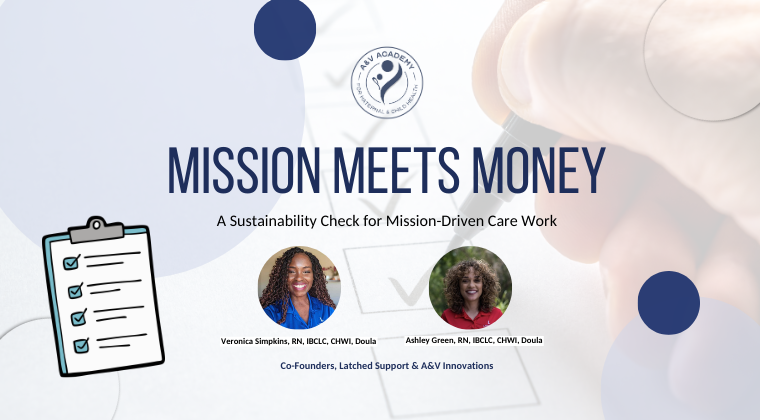
The Mission Meets Money Sustainability Check was created as a first step.
It is a short, reflective tool designed to help birth workers, IBCLCs, and community health professionals identify where they are right now and what needs support before burnout sets in.
If this blog resonated, the Sustainability Check offers clarity without pressure.
Your mission deserves a structure that can hold it.
